Medical devices
Precision mesh and components for medical devices
We supply Sefar woven monofilament fabrics SEFAR MEDIFAB® and the specialty media SEFAR MEDITEX, as fabric or finished components. Sefar manufactures with traceability to ISO 13485, in ISO Class 7 cleanrooms and with biocompatibility to USP Class VI and ISO 10993.
- Traceability and quality system
- ISO 13485
- Cleanroom class for manufacturing
- ISO 7
- Endotoxin content, SEFAR MEDIFAB
- ≪ 0.125 EU/ml
- Smallest pore size, SEFAR MEDIFAB
- 1 µm
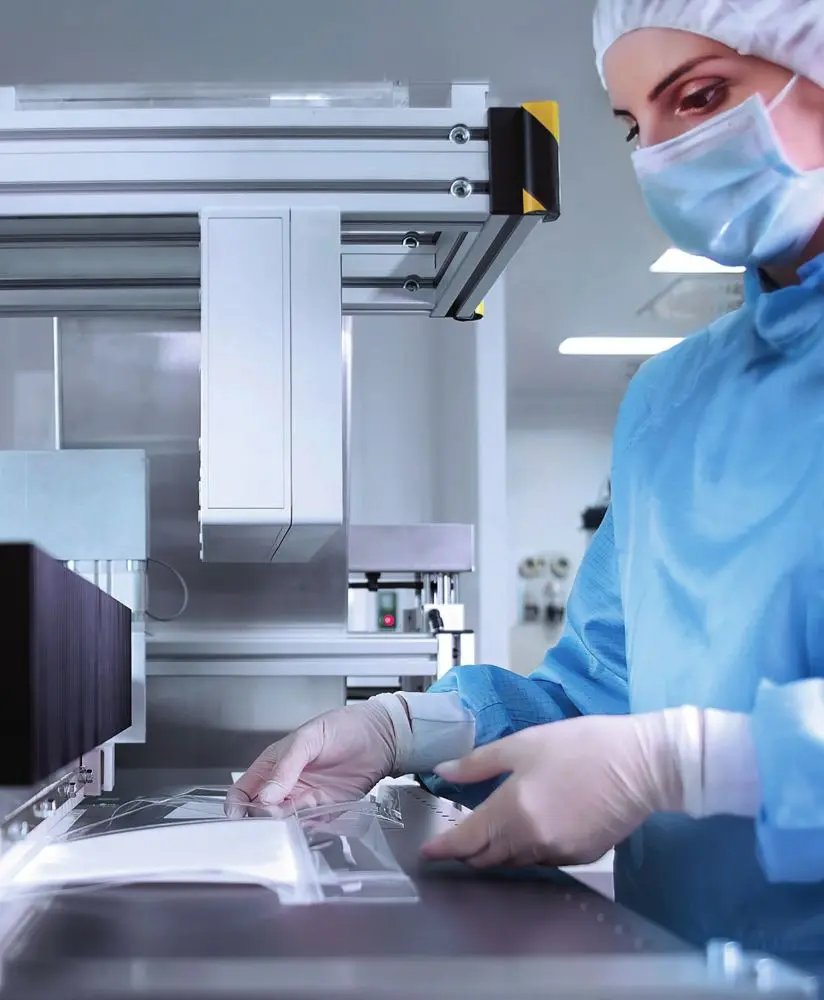
From polymer to finished component
Sefar handles the whole chain in-house: polymer, yarn, weaving, finishing, fabrication of components and quality control. Complete process control gives consistent quality and full traceability to ISO 13485.
Sefar describes itself as the leading producer of woven monofilament fabrics and a supplier of fabricated parts for medical applications. Solutions are developed together with the customer, supported by the Sefar medical team.
Applications in Class I and Class II
Sefar supplies fabrics and parts for medical devices in several risk classes. The brochure gives the following examples.
| Risk class | Examples according to Sefar |
|---|---|
| Class I, low risk | Hospital beds, urine bags, biopsy bags, diagnostics |
| Class II, moderate risk | Infusion, transfusion, dialysis, perfusion, wound care |
According to Sefar, it is the responsibility of the medical device manufacturer to determine that all components and raw materials, including Sefar products, are suitable and meet the requirements of the regulatory bodies in the final product.
Function in the device
SEFAR MEDIFAB acts as a security filter and as a wicking and spreading medium, for example in:
- Infusion and transfusion sets
- Arterial and cardiotomy blood filters
- Blood bags
- Dialysis sets
- Diagnostic self-test strips
SEFAR MEDIFAB: open mesh monofilament fabrics
SEFAR MEDIFAB are open mesh fabrics woven from monofilament yarns and developed for medical devices. Precise mesh openings, a uniform weave and an open structure give accurate filtration with minimal flow restriction. Pore sizes go down to 1 µm.
The standard materials are polyester (PET, code 07) and polyamide 6.6 (PA, code 03). PEEK and PP can be supplied in MEDIFAB quality on request. The article number gives material, mesh opening and open area: 07-40/25 is PET with a 40 µm mesh opening and 25% open area.
| Article | Mesh opening (µm) | Open area (%) | Threads per cm | Thread diameter (µm) | Weight (g/m²) | Thickness (µm) |
|---|---|---|---|---|---|---|
| 07-11/5 | 11 | 5 | 206 | 38 | 50 | 60 |
| 07-15/9 | 15 | 9 | 194 | 37 | 45 | 55 |
| 07-20/13 | 20 | 13 | 177 | 37 | 40 | 60 |
| 07-21/12 | 21 | 12 | 163 | 41 | 45 | 70 |
| 07-27/19 | 27 | 19 | 162 | 35 | 35 | 55 |
| 07-33/10 | 33 | 10 | 93 | 75 | 85 | 125 |
| 07-40/25 | 40 | 25 | 126 | 40 | 35 | 60 |
| 07-51/33 | 51 | 33 | 113 | 38 | 30 | 60 |
| 07-74/34 | 74 | 34 | 78 | 54 | 45 | 85 |
| 07-100/32 | 100 | 32 | 57 | 77 | 65 | 125 |
| 07-105/52 | 105 | 52 | 69 | 42 | 25 | 61 |
| 07-115/36 | 115 | 36 | 54 | 70 | 55 | 105 |
| 07-135/40 | 135 | 40 | 48 | 73 | 55 | 115 |
| 07-150/41 | 150 | 41 | 43 | 86 | 65 | 140 |
| 07-175/46 | 175 | 46 | 39 | 83 | 55 | 130 |
| 07-185/41 | 185 | 41 | 35 | 105 | 80 | 170 |
| 07-200/43 | 200 | 43 | 33 | 104 | 75 | 170 |
| 07-265/47 | 265 | 47 | 26 | 122 | 85 | 200 |
| 07-800/55 | 800 | 55 | 9 | 280 | 165 | 520 |
| 03-15/10 | 15 | 10 | 202 | 35 | 40 | 60 |
| 03-30/18 | 30 | 18 | 142 | 40 | 35 | 60 |
| 03-41/31 | 41 | 31 | 136 | 33 | 25 | 50 |
| 03-60/42 | 60 | 42 | 108 | 33 | 20 | 50 |
| 03-200/47 | 200 | 47 | 34 | 92 | 55 | 150 |
Polyamide 6 and 6.6 can absorb up to 4% moisture, which causes dimensional changes that according to Sefar are normally reversible. Sefar therefore processes PA products in a stable climatic environment. The range also includes the fabrics 07-5/1 and 03-5/1. Ask for the current data sheet.
SEFAR MEDITEX: specialty media
SEFAR MEDITEX is the Sefar product line for medical applications with requirements other than an open mesh. Function and regulatory properties are tailored to the customer’s requirements.
- Specialty polymers and special weave constructions
- Knitted multifilament
- Coloured fabrics for corporate identity, automation and identification
- Membranes for microfiltration
- Composite membranes for nano- and microfiltration
- Multiple bonded layers
- Calendering
- Hydrophobic or hydrophilic treatment
Biocompatibility and testing
Sefar medical fabrics are biocompatible to USP Class VI and ISO 10993, and they are non-pyrogenic, non-hemolytic and non-cytotoxic. For SEFAR MEDIFAB, Sefar lists the following tests.
| Test | Method | Standard |
|---|---|---|
| Cytotoxicity | ISO elution method | ISO 10993-5 |
| Sensitisation | Maximisation test | ISO 10993-10 |
| Irritation | Intracutaneous test | ISO 10993-10 |
| Acute systemic toxicity | Systemic toxicity study | ISO 10993-11 |
| Genotoxicity | Extraction and gas chromatography | ISO 10993-3 |
| Chemical characterisation | Extraction and gas chromatography | ISO 10993-18 |
| CMR substances | Extraction and gas chromatography | MDR Annex I, Ch. II, 10.4 |
| Endotoxin (process requirement) | Kinetic-turbidimetric LAL method | USP <85> |
| Hemocompatibility (process requirement) | In vitro hemolysis study on extract | ISO 10993-4 |
Limits and raw materials for SEFAR MEDIFAB
- Endotoxin content far below 0.125 EU/ml, the limit in USP <85>
- No hemolysis according to ISO 1135-4
- Extractables below the limits in 21 CFR 177.1500 (polyamide) and 21 CFR 177.1630 (polyester)
- The yarns are produced to 21 CFR 177 and European guidelines
- A separate, validated processing line ensures high cleanliness and biocompatibility
- Endotoxins and hemolysis are tested routinely. USP Class VI, ISO 10993 and cytotoxicity are tested at regular intervals
- No ozone-depleting substances are used in production
Fabrication and surface treatment
Sefar makes finished filter components in ISO Class 7 cleanrooms to ISO 14644-1. All components can be made to the medical device manufacturer’s specification.
| Process | Methods |
|---|---|
| Cutting | Laser, heat, ultrasonic, cold cutting |
| Stamping | Ultrasonic, cold stamping |
| Slitting | Ultrasonic, heat, laser |
| Joining and forming | Ultrasonic welding, pleating, tubing, crosswinding |
Surface treatment and dyeing
SEFAR MEDIFAB meets the pyrogen and hemolysis requirements without coating or surface treatment. Optional hydrophilic and hydrophobic coatings and plasma treatments are available, for example to improve priming, wetting and wicking. The fabrics can be dyed in virtually any colour, and customer-specific formulations are available on request.
Development, validation and documentation
Sefar produces prototypes for testing quickly, thanks to its broad range of materials and in-house fabrication. The development process supports the customer’s Installation, Operational and Performance Qualification (IQ, OQ and PQ).
The work follows five gates, from trial samples through unqualified and qualified samples to serial items:
- Gate 1: project start
- Gate 2: design input freeze
- Gate 3: design and process freeze
- Gate 4: product release
- Gate 5: production release
Sefar offers free samples of SEFAR MEDIFAB.
Quality system and certifications
As a certified component supplier to the medical industry, Sefar has a quality management system covering both regulatory standards and customer-specific requirements. To prevent deviations, Sefar provides comprehensive documentation, full traceability and no-change agreements.
- ISO 13485, ISO 9001 and ISO 14001
- Manufacturing in ISO Class 7 cleanrooms
- Biocompatibility to USP Class VI and ISO 10993
Bigman as your supplier
Bigman is the Sefar distributor in Sweden, Norway and Iceland and has worked with Sefar since 1970. We advise on fabric and design and supply fabric by the running metre or as fabricated parts.
Products we have developed for you can be stocked in Spånga, so your flow of goods does not stop. The lead time is given once the product has been developed.
Frequently asked questions
Which certifications do Sefar medical fabrics have?
Sefar is certified to ISO 13485, ISO 9001 and ISO 14001 and manufactures in ISO Class 7 cleanrooms. SEFAR MEDIFAB is biocompatible to USP Class VI and ISO 10993 and is tested for endotoxin to USP <85> and hemocompatibility to ISO 10993-4.
Can SEFAR MEDIFAB be supplied as finished components?
Yes. Sefar cuts, stamps, slits, ultrasonically welds, pleats, and makes tubing and crosswinding in ISO Class 7 cleanrooms. The components are made to the customer’s specification.
Who is responsible for the component working in the finished device?
According to Sefar, the medical device manufacturer is responsible for determining that all components and raw materials, including Sefar products, are suitable and meet the requirements of the regulatory bodies in the final product. Sefar supports this with documentation, traceability and the customer’s IQ, OQ and PQ.
Which materials is MEDIFAB available in?
The standard is polyester (PET) and polyamide 6.6 (PA). PEEK and PP can be supplied in MEDIFAB quality on request.