Filter cloth
Synthetic filter cloth for process filtration
Sefar weaves filter cloth from monofilament and multifilament in PA, PET, PP, PEEK and fluoropolymers, among others, and makes needle felt for dust filters. The monofilament comes in thread diameters from 19 µm to 2,000 µm and gives mesh openings from 5 µm to 5,000 µm. We supply the cloth by the metre or fabricated.
- thread diameter, monofilament
- 19–2,000 µm
- mesh opening, monofilament cloth
- 5–5,000 µm
- pore size, double layer weave for vacuum belt filters
- 7–160 µm
- dry working temperature, PEEK
- up to 250 °C
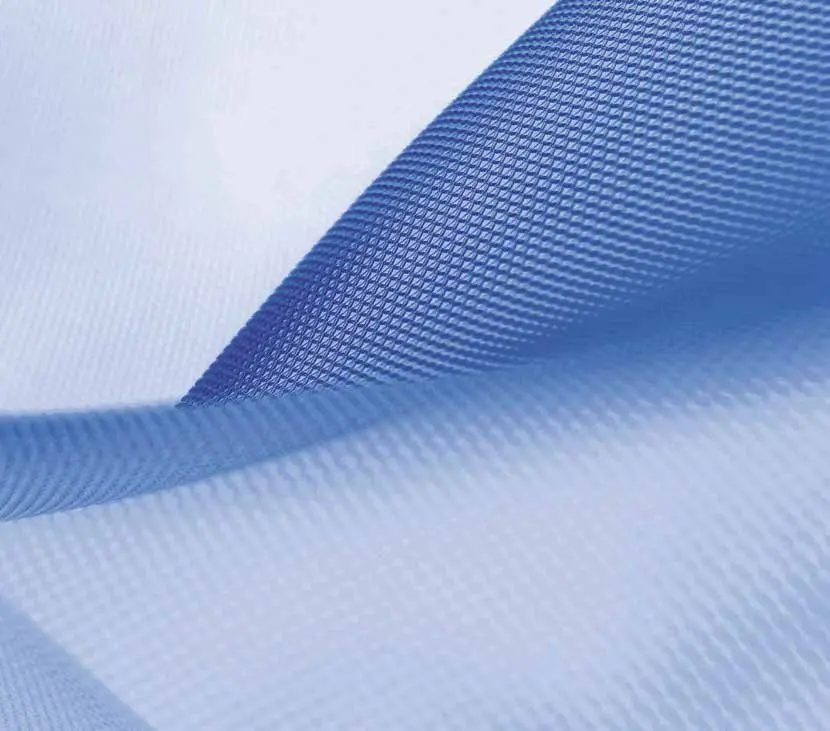
Three basic types: monofilament, multifilament and needle felt
A filter cloth is either woven from monofilament, woven from multifilament or needled as a felt. The choice controls particle retention, permeability, cake release and how easily the cloth can be cleaned. According to Sefar, it is the leading manufacturer of precision monofilament fabrics.
Monofilament cloth
Monofilament is a solid thread made of a single filament. It gives fabrics with precise and reproducible mesh openings. Sefar describes SEFAR TETEX® MONO as offering maximum particle retention at maximum permeability, with optimum cleaning properties. In rotary disc filters, elastic monofilament cloth gives good cake release, according to Sefar.
Multifilament cloth
Multifilament is twisted from many fine filaments. The cloth is denser and more flexible. Sefar describes SEFAR TETEX MULTI as offering maximum particle retention, good strength and flexibility.
The difference shows in the air permeability. In Sefar's PHARMA range for centrifuges and nutsche filters, the multifilament cloths are at 4–25 l/(m²·s) and the monofilament cloths at 30–170 l/(m²·s).
Double and multi layer weave
SEFAR TETEX DLW (double layer weave) and SEFAR TETEX MLW (multi layer weave) join two or more fabric layers during weaving. A fine layer filters and a coarser layer drains and supports. Sefar states high vertical and lateral liquid flow and good resistance to creasing and mechanical stress.
| Property | Fine single layer | Coarse single layer | SEFAR TETEX DLW |
|---|---|---|---|
| Filtration | Fine | Coarse | Fine |
| Throughput | Low | High | High |
| Filtrate turbidity | Low | High | Low |
| Belt strength | Weak | Strong | Strong |
| Active filter area | Reduced | Reduced | Improved |
Needle felt
Needle felt is a felt of fibres needled together into a thicker medium. Sefar uses SEFAR TETEX NF for filter bags for dust filtration and powder recovery. The surface is singed, meaning that protruding fibres are burnt off, so that the filter cake releases more easily. Depending on the fibre, the needle felt withstands 90–250 °C in continuous operation.
Weave types
Sefar weaves plain weave, twill weave, dutch weave, plain reverse dutch weave and satin weave. For sieving there is also leno weave, for example SEFAR NYTAL® PA-Leno weave. Sefar compares the three basic types as follows:
| Property | Plain weave | Twill weave | Satin weave |
|---|---|---|---|
| Min. pattern repeat (threads) | 2 | 3 | 5 |
| Slip resistance | Very good | Good | Limited to poor |
| Elongation | Very good | Good | Limited to poor |
| Tensile strength | Limited to poor | Good | Very good |
| Maximum thread density | Limited to poor | Good | Very good |
| Stiffness | Very good | Good | Limited to poor |
| Permeability | Limited to poor | Good | Very good |
| Drapability | Limited to poor | Good | Very good |
Mesh opening, pore size and other dimensions
The mesh opening is the distance between two adjacent warp or weft threads. Open area is the sum of all mesh openings as a percentage of the cloth area. Sefar checks mesh opening, thread count, open area, thickness and air permeability with optical or pressure-sensitive equipment.
| Dimension | Unit | Definition or method |
|---|---|---|
| Mesh opening (w) | µm | The distance between two adjacent threads |
| Open area (a₀) | % | The sum of the mesh openings as a percentage of the cloth area |
| Thread count (n) | threads/cm or /inch | Number of threads per cm or inch |
| Thread diameter (d) | µm | Measured on the thread before weaving |
| Thickness (D) | µm | The thickness of the cloth |
| Weight | g/m² | Gravimetric, to DIN EN 12127 |
| Air permeability | l/(m²·s) | Air flow at a pressure drop, to DIN EN ISO 9237 |
Typical ranges in Sefar's brochures
| Cloth | Range |
|---|---|
| Monofilament, thread diameter | 19–2,000 µm |
| Monofilament, mesh opening | 5–5,000 µm |
| SEFAR TETEX DLW and MLW, filter belts for vacuum belt filters | Pore size 7–160 µm |
| Double layer weave PHARMA in PP and PEEK, centrifuge and nutsche | Nominal pore size 7–120 µm |
| Monofilament PHARMA in PP, centrifuge and nutsche | Nominal pore size 14–53 µm |
| SEFAR TETEX DRY, belts for vacuum belt dryers | Air permeability 100–2,500 l/(m²·s) |
Materials
Temperature, chemicals, mechanical load and hygiene requirements govern the choice of material. Sefar gives each polymer a material code, and the code comes first in the article number. For example, 05-8000 is a PP cloth and 17-8000 is the same construction in PEEK.
| Material | Sefar code | Dry working temperature | Characteristics according to Sefar |
|---|---|---|---|
| Polyamide PA 6.6 | 03 | −40 to +115 °C | Good abrasion resistance and alkali resistance, absorbs 3.5–4% moisture, turns yellow above 100 °C |
| Polypropylene PP | 05 | −30 to +90 °C | Good acid and alkali resistance, absorbs no moisture, lowest density |
| Polyester PET | 07 | −75 to +150 °C | Good acid resistance, limited against alkalis and hydrolysis |
| PVDF | 02 | 110 °C | Good acid and alkali resistance, limited against solvents |
| ECTFE | 08 | up to 140 °C | Good resistance in almost all chemical groups |
| PPS | 25 | up to 190 °C | Good against solvents and hydrolysis, limited against acids and alkalis |
| PTFE | 24 | up to 240 °C | Rated good against all chemicals in Sefar's table |
| PEEK | 17 | up to 250 °C | Highest working temperature, good abrasion resistance, rated unsatisfactory against hydrofluoric acid and aqua regia, among others |
Sefar's values are guide values from the fibre manufacturers' data, usually at 20 °C. Sefar requires laboratory and field tests before industrial use. Lower limits apply in wet operation, for example 75 °C for PP and 140 °C for PEEK in vacuum belt filters.
Finishing and surface treatment
The greige fabric is finished chemically or physically to give the properties the process requires. Sefar mentions coating, heat setting, calendering, chemical finishing, plasma treatment and dyeing.
- Calendering: filter press cloths with special weaves and a high degree of calendering give better cake release, clear filtrate and a dry filter cake.
- Conductive and antistatic fabrics: for fluid bed dryers, where Sefar states a reduced risk of explosion.
- Scaling retardant design: for pressure leaf filters in mineral applications.
- Heat-resistant finish: for vacuum belt filters on request.
- Hydrophobic and oleophobic or hydrophilic coating, and plasma treatment.
- Needle felt: singeing, glazing, water- and oil-repellent impregnation, antistatic felt, spark protection, PTFE finish, fine fibre blend and ePTFE membrane.
Edges, closures and fabrication
Sefar fabricates the cloth into finished parts that fit the machine: bags, belts, segments, socks and cloths. Cutting is done by heat, ultrasound or laser, and seams are sewn or welded. Welded seams have no stitching holes, so no product is lost through the stitches.
| Machine | Designs |
|---|---|
| Vacuum belt filter | Metal clippers in various grades, reinforced closure area, overlap or underlap, sealing thread, Velcro as an option, heat cut and coated edges, marking of cake side and running direction |
| Vacuum belt dryer | Taped edge (standard), welded edge, sewn edge, heat cut and pressed edge, metal clipper Alligator with seam (standard), clipper closure |
| Centrifuge | Endless liners, overlap welded or butt welded, edges with band, tape or cut edge |
| Nutsche filters and horizontal discs | Hemmed, taped, twisted or laser cut edge |
| Filter press | Coating, laser cutting and sewing, non-metallic eyelets |
| Drum filter | Belts with fish-mouth closure |
| Coolant belt filter | Particle-tight closures, transport bars for large vacuum filters, magnetic indicator strips for pressure belt filters |
| Baghouse | Bags with snap band, felt collar or metal ring |
Product names in Sefar's range
Sefar sells its filter cloths under a few product families. The letters after the family name indicate the construction or treatment.
| Product family | Construction | Used in |
|---|---|---|
| SEFAR TETEX MONO | Monofilament cloth | Disc, drum, leaf, candle and nutsche filters, centrifuges |
| SEFAR TETEX MULTI | Multifilament cloth | Drum filters, vacuum leaf filters, pressure plate filters, centrifuges |
| SEFAR TETEX DLW | Double layer weave with drainage layer, in the Classic, HC, HD and Coolant variants | Vacuum belt filters, centrifuges, nutsche filters, coolant filters |
| SEFAR TETEX MLW | Multi layer weave, highest mechanical strength | Vacuum belt filters |
| SEFAR TETEX DRY | Belts in PET or PPS | Vacuum belt dryers |
| SEFAR TETEX NF | Needle felt, with the treatments NFG, NFI, NFA, NFS, NFP, NFF and NFM | Baghouses |
| SEFAR NYTAL | Precision fabrics for sieving, for example PA-HD, PA-XXX, PA-MF and PA-Milling | Plansifters, rebolters, centrifugal sifters |
| SEFAR NITEX | Precision fabric | Centrifugal sifters |
Filter cloth from Bigman
Bigman has been Sefar's distributor in Sweden, Norway and Iceland since 1970. We help you choose material and weave for your process.
- Cloth on the roll and by the metre.
- Finished parts made to your drawing or your original.
- Customer stock in Spånga for parts we have developed for you.
- The lead time is set once the product has been developed.
Frequently asked questions
What is the difference between monofilament and multifilament filter cloth?
Monofilament cloth is woven from solid single threads and has precise mesh openings, high permeability and is easy to clean. Multifilament cloth is woven from twisted threads and is denser and more flexible. In Sefar's PHARMA range, the multifilament cloths have an air permeability of 4–25 l/(m²·s), compared with 30–170 l/(m²·s) for monofilament.
What do the first digits in Sefar's article numbers mean?
The first two digits are Sefar's material code, for example 03 for PA 6.6, 05 for PP, 07 for PET, 08 for ECTFE, 17 for PEEK and 25 for PPS.
Can I buy filter cloth by the metre?
Yes. We supply Sefar filter cloth on the roll and by the metre, or as finished parts made to drawing or original.